


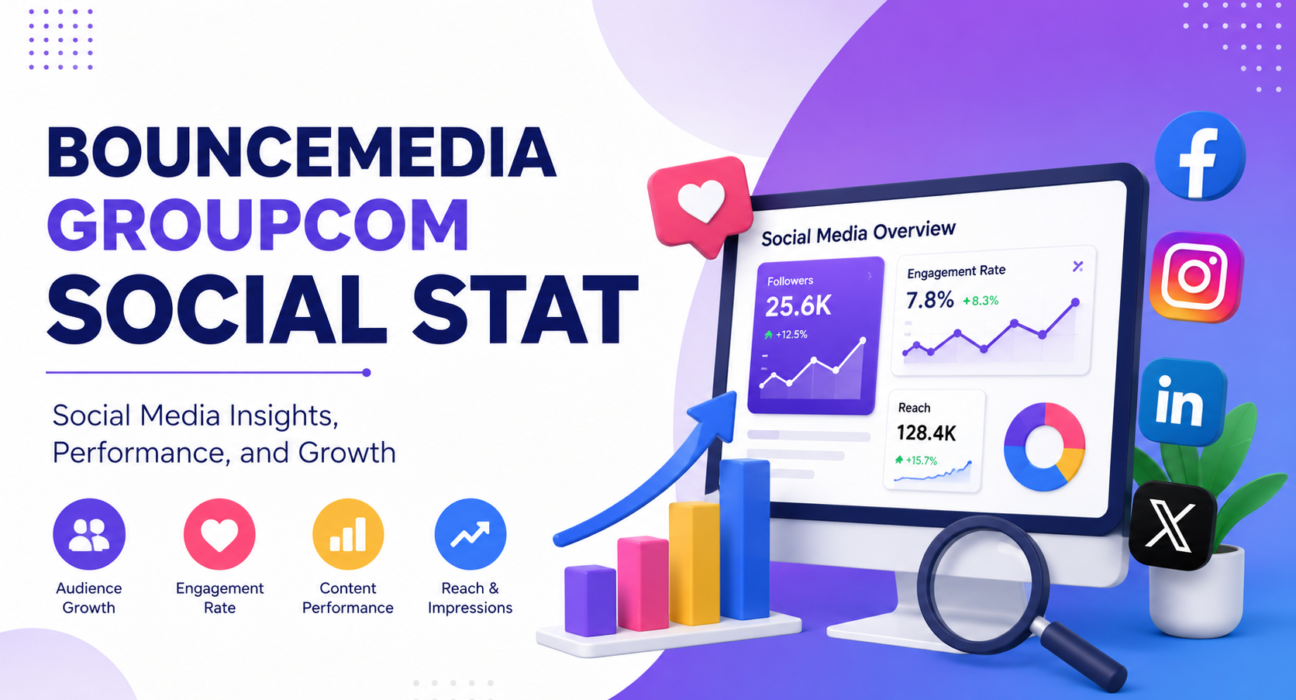
In today’s digital landscape, social media has become one of the most important channels for businesses, brands, and content creators. Organizations rely on platforms such as Facebook, Instagram, X, LinkedIn, TikTok, and YouTube to connect with audiences, strengthen brand awareness, and drive business growth. As competition increases across these platforms, measuring performance accurately has become essential.
The term bouncemediagroupcom social stat has gained attention among people interested in understanding how digital media organizations track social performance, audience engagement, and online growth. Social statistics provide valuable insights into how content performs, how audiences interact with brands, and how marketing strategies can be improved over time.
This article explores the concept of social statistics, their importance in modern digital marketing, how media-focused organizations analyze social performance, and why understanding these metrics is crucial for long-term success.
The Growing Importance of Social Media Analytics
Social media is no longer simply a platform for communication. It has evolved into a powerful ecosystem where businesses build communities, generate leads, promote products, and influence purchasing decisions.
Every interaction on social media creates data. Likes, shares, comments, impressions, clicks, video views, and follower growth all contribute to a broader picture of audience behavior. Without analyzing these metrics, organizations may struggle to understand whether their efforts are producing meaningful results.
The concept behind bouncemediagroupcom social stat reflects the increasing focus on data-driven decision-making. Rather than relying on assumptions, businesses can use measurable information to determine what content resonates with audiences and what areas require improvement.
Analytics help transform social media from a guessing game into a strategic business tool.
What Are Social Statistics?
Social statistics refer to measurable data collected from social media platforms. These numbers reveal how users interact with content and how effectively a brand reaches its target audience.
Common social statistics include audience growth, engagement rates, content reach, impressions, click-through rates, video completion rates, and conversions. Each metric serves a different purpose and contributes to a more complete understanding of performance.
When examining bouncemediagroupcom social stat, the focus typically centers on evaluating how social channels perform over time. These insights help organizations identify trends, monitor audience preferences, and optimize future campaigns.
Social statistics are not just numbers on a dashboard. They represent real audience behavior and provide evidence that supports strategic decisions.
Why Social Statistics Matter for Digital Brands
Digital brands operate in a highly competitive environment where attention is limited and audience expectations constantly evolve.
Social statistics offer several important benefits.
First, they help measure content effectiveness. Brands can identify which posts generate strong engagement and which fail to attract attention.
Second, analytics improve audience understanding. Businesses gain insight into demographics, interests, locations, and online behaviors.
Third, social data supports marketing optimization. Campaigns can be adjusted based on actual performance rather than assumptions.
Fourth, statistics help demonstrate return on investment. Marketing teams can connect social media efforts to broader business objectives.
The increasing interest in bouncemediagroupcom social stat reflects a broader shift toward accountability and measurable performance in digital marketing.
Key Metrics That Define Social Performance
Understanding social media performance requires examining multiple metrics rather than relying on a single number.
Reach measures how many unique users see content. A high reach indicates strong visibility and distribution.
Impressions represent the total number of times content appears on screens. Unlike reach, impressions may include multiple views by the same user.
Engagement measures user interactions such as likes, comments, shares, saves, and reactions. High engagement often signals content relevance and audience interest.
Follower growth tracks audience expansion over time. Consistent growth may indicate increasing brand awareness.
Click-through rates show how often users click links after viewing content. This metric is especially important for driving website traffic.
Video metrics reveal viewing behavior, including watch time, completion rates, and audience retention.
These indicators collectively contribute to the overall picture often associated with bouncemediagroupcom social stat, providing valuable insights into audience interaction and campaign success.
The Relationship Between Content Strategy and Social Metrics
Content strategy and analytics are closely connected. Effective content drives strong metrics, while analytics help refine future content decisions.
Successful organizations continuously analyze social performance to identify patterns. They evaluate which topics generate interest, which formats encourage engagement, and which publishing schedules maximize visibility.
For example, short-form videos may outperform static images in some industries. Educational content may attract more shares than promotional posts. Storytelling-focused content may generate stronger emotional connections with audiences.
Analytics provide the evidence needed to make informed adjustments.
When discussing bouncemediagroupcom social stat, one of the most valuable aspects is understanding how social data influences content planning and strategic decision-making.
Audience Behavior and Social Insights
One of the greatest advantages of social media analytics is the ability to understand audience behavior in detail.
Modern platforms collect extensive information about user interactions. Businesses can learn when audiences are most active, what content they prefer, how long they engage with videos, and what actions they take after viewing posts.
This information helps marketers create more relevant and effective content.
Audience behavior analysis also supports personalization. Rather than delivering generic messages, brands can tailor content to specific audience segments.
As a result, engagement often improves, relationships become stronger, and marketing resources are used more efficiently.
The value of bouncemediagroupcom social stat lies partly in its ability to reveal these behavioral patterns and transform raw data into actionable insights.
How Social Statistics Support Brand Growth
Brand growth rarely happens by accident. Successful expansion typically results from consistent strategy, audience understanding, and performance measurement.
Social statistics contribute to growth in several ways.
They identify high-performing content themes that can be replicated.
They reveal opportunities to strengthen audience relationships.
They help optimize advertising campaigns.
They support influencer collaborations by measuring campaign effectiveness.
They highlight emerging trends before competitors recognize them.
Organizations that regularly analyze social data often adapt more quickly to market changes and audience expectations.
For businesses seeking sustainable growth, social statistics serve as an essential navigation system that guides decision-making and strategic development.
The Role of Data in Modern Media Organizations
Media organizations generate large volumes of content and engage with diverse audiences across multiple platforms.
Managing this complexity requires sophisticated measurement systems.
Data helps media teams understand which stories generate interest, which formats attract engagement, and which distribution channels deliver the best results.
Analytics also support editorial decisions. Content creators can evaluate audience preferences while maintaining quality and relevance.
In many cases, discussions around bouncemediagroupcom social stat emphasize the importance of using measurable insights to strengthen digital media performance and audience engagement strategies.
Data-driven approaches reduce uncertainty and enable more informed planning.
Challenges in Interpreting Social Statistics
While social statistics provide valuable information, interpreting them correctly can be challenging.
High follower counts do not always indicate strong engagement. Large audiences may remain inactive if content lacks relevance.
Similarly, viral content may generate impressive reach without producing meaningful business outcomes.
Context is essential when evaluating metrics. A successful campaign should align with specific objectives rather than focusing solely on vanity metrics.
Changes in platform algorithms can also affect performance. A decline in reach may result from algorithm updates rather than content quality issues.
Therefore, organizations must analyze metrics holistically and avoid drawing conclusions based on isolated numbers.
Understanding these complexities is an important part of effectively using bouncemediagroupcom social stat for strategic decision-making.
Future Trends in Social Media Analytics
Social media analytics continues to evolve alongside technological advancements and changing user behaviors.
Artificial intelligence is becoming increasingly important in data analysis. AI-powered tools can identify trends, predict audience behavior, and automate reporting processes.
Predictive analytics may help organizations anticipate future performance rather than simply analyzing past results.
Cross-platform measurement is also gaining importance. Brands increasingly seek unified views of performance across multiple social networks.
Privacy regulations and evolving data policies will continue influencing how social information is collected and analyzed.
Additionally, sentiment analysis is expected to play a larger role. Beyond measuring engagement, organizations want to understand audience emotions and perceptions.
The future of analytics will likely focus on deeper insights, greater automation, and more actionable intelligence.
Building a Data-Driven Social Strategy
Creating an effective social strategy requires more than publishing content regularly.
Organizations should begin by defining clear objectives. Goals may include increasing brand awareness, driving website traffic, generating leads, or improving customer engagement.
Next, relevant metrics should be selected based on those objectives.
Regular monitoring allows teams to identify performance trends and adjust strategies when necessary.
Experimentation is equally important. Testing different formats, messaging styles, and posting schedules helps uncover opportunities for improvement.
Continuous learning and optimization form the foundation of successful social media management.
A strong understanding of bouncemediagroupcom social stat can support this process by providing the insights needed to make informed decisions and achieve measurable outcomes.
Conclusion
Social media has become a central component of modern communication, marketing, and brand development. As digital competition grows, organizations must rely on accurate data to understand audience behavior, evaluate content performance, and improve strategic outcomes.
The concept of bouncemediagroupcom social stat highlights the broader importance of social media analytics in today’s digital environment. By examining key metrics such as engagement, reach, impressions, follower growth, and audience behavior, businesses can gain valuable insights that support smarter decision-making.
Social statistics are far more than simple numbers. They represent opportunities to strengthen audience relationships, improve content strategies, optimize marketing investments, and drive long-term growth. Organizations that embrace data-driven approaches are better positioned to adapt to changing trends and succeed in an increasingly competitive digital world.
As social platforms continue evolving, the ability to understand and apply meaningful analytics will remain a critical advantage for businesses, media organizations, and content creators alike.